
What Foundation Strategy Means on Live Projects
Foundation strategy is not a preference for a dig method. It is the engineered and commercial choice of how loads reach competent ground within acceptable settlement, delivered through packages that can actually be built on the plot with the plant, access and programme available.
Developers and PMs who treat strategy as “we’ll do strips unless something looks soft” discover that something often does — after tender, after award, and after sales have assumed early plot starts. Strategy should be frozen enough to procure, with a defined change path when formation differs from assumptions.
Mainline helps procure and deliver the chosen strategy to design. We are not the structural or geotechnical designer. Design responsibility remains with the appointed professionals. This guide explains the commercial walkthrough that sits between soil bearing capacity explained and a tenderable foundation contractors or piling contractors package.
Why Strategy Matters Before Price
Price without strategy produces false competition. Strip, raft and piled solutions carry different prelims, testing, temporary works and interface risks. Comparing a shallow fixed price against a piled provisional sum as if they were the same product is how awards go wrong.
Strategy also sets the sales and valuation narrative. Housebuilders releasing plots against a master programme need foundation gates that match infrastructure gates — not a hope that every plot will start on the optimistic shallow case. Mixed strategies across a phase are possible, but only when design and package ownership are explicit.
On Groundworks for Housebuilders and Groundworks for Developers schemes, foundation strategy is often decided under time pressure between GI receipt and tender release. That is exactly when skipping buildability review is most expensive.
Decision Sequence: From GI to Package
Start with investigation quality and limitations — see ground investigation before build and ground conditions risk explained. If recommendations are provisional, strategy is not ready for a hard fixed price.
Next, align structural form and loads with geotechnical recommendations. The designer translates bearing, settlement, heave, trees, groundwater and slopes into a foundation system. Commercial teams should demand a recommendation that can be drawn and tendered, not only a menu of “options for consideration.”
Then test buildability: access width, headroom, neighbour constraints, crane or rig feasibility, spoil route, wet-weather resilience, and whether plot phasing allows the method. A piled solution that cannot get a rig to the rear plots is not a strategy — it is a drawing.
Then define package splits: who excavates, who piles, who constructs caps and ground beams, who owns formation, who arranges testing, who coordinates Building Control notices. Ambiguity here becomes standby and dispute later.
Finally, release procurement with information maturity matched to the contract form. Where strategy is still optioneering, early contractor involvement can help — without cloning ECI into this guide. Where strategy is frozen, structured tendering can compete like-for-like methods.
Key Inputs That Shape Viable Options
Ground evidence and bearing language are the first gate — covered in depth in soil bearing capacity explained. Weak evidence forces contingency and incompatible tender assumptions.
Loads and structural form decide stiffness and foundation type. Changing the superstructure late can invalidate a foundation strategy that was already procured.
Trees, clay, groundwater and slopes drive depth, heave precautions, dewatering and retaining interfaces. These are not “extras”; they are strategy drivers that should appear in the design narrative before tender.
Access and logistics constrain plant. Urban infill, occupied neighbours and tight estate roads often push mini-piling or sequenced shallow digs even when open-field shallow would have been cheaper in the abstract.
Programme and sales phasing constrain how much float exists for testing and method change. Early infrastructure adoption gates can also dictate when plots can start — coordinate with managing multiple plot programmes.
| Input | Why it shapes strategy | If weak or late… |
|---|---|---|
| Ground investigation + bearing evidence | Shallow vs raft vs pile / improvement viability | Strategy changes after tender |
| Loads and structural form | Foundation type and stiffness requirements | Under- or over-specified packages |
| Trees, clay, groundwater, slopes | Depth, heave, dewatering, retaining interfaces | Late temporary works and programme slip |
| Access and buildability | Plant choice, piling feasibility, plot phasing | Method that cannot be delivered on the plot |
| Programme / package split | Who digs, who piles, who tests, who owns formation | Interface disputes and standby |
Option Walkthrough: Strip, Raft, Pile, Improvement
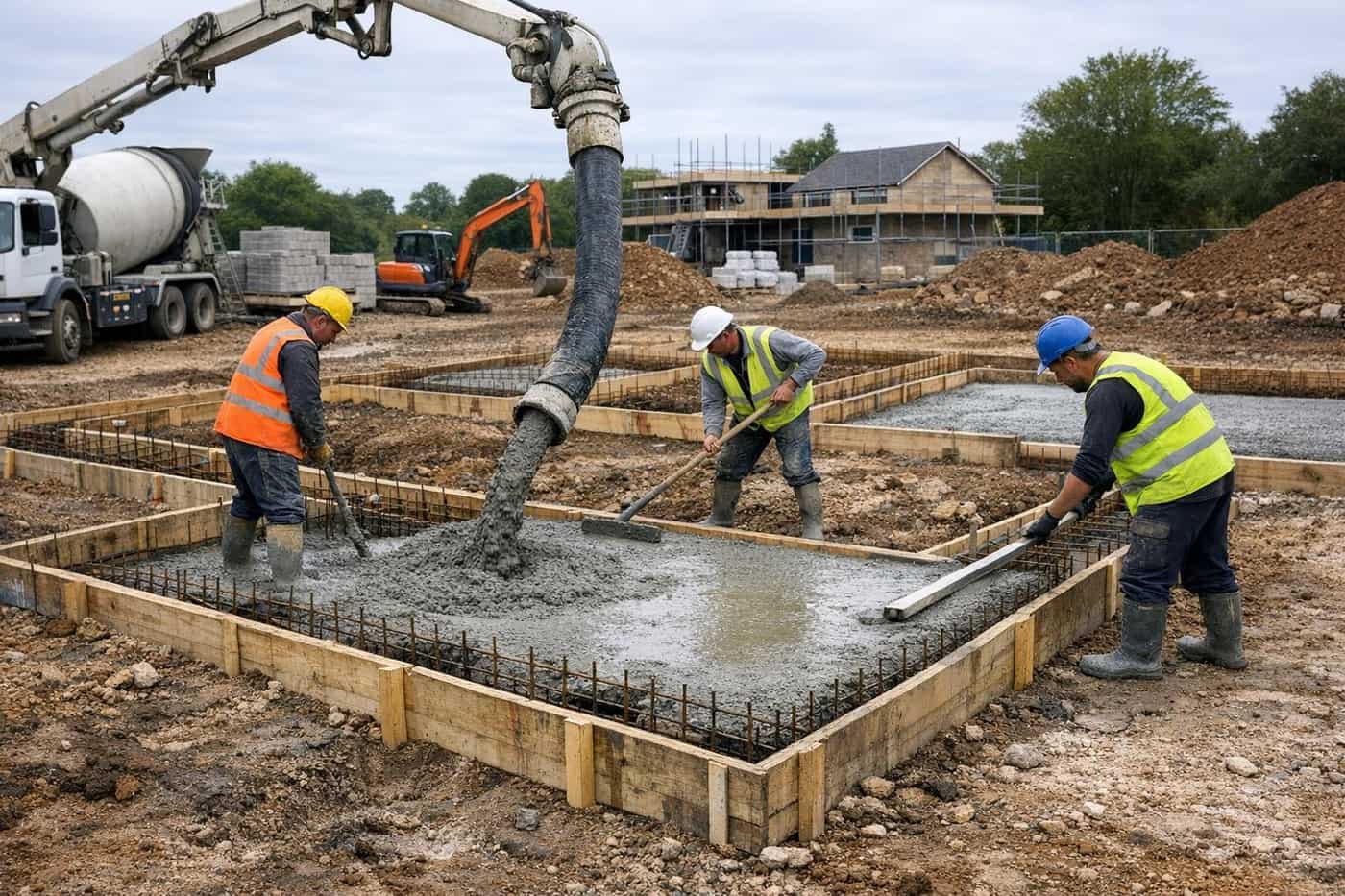
Shallow strip, trench fill and pad foundations are often the default where ground and loads allow. Commercially they are sensitive to soft-spot volume, weather and formation discipline. They usually pair with conventional excavation plant and Building Control foundation inspections.
Rafts change the excavation and concrete profile and can be chosen where designers need a different settlement performance. Pour logistics, edge details and services under or through the raft become package-critical. Comparing raft prelims to strip dig rates without redesign is not value engineering — it is noise.
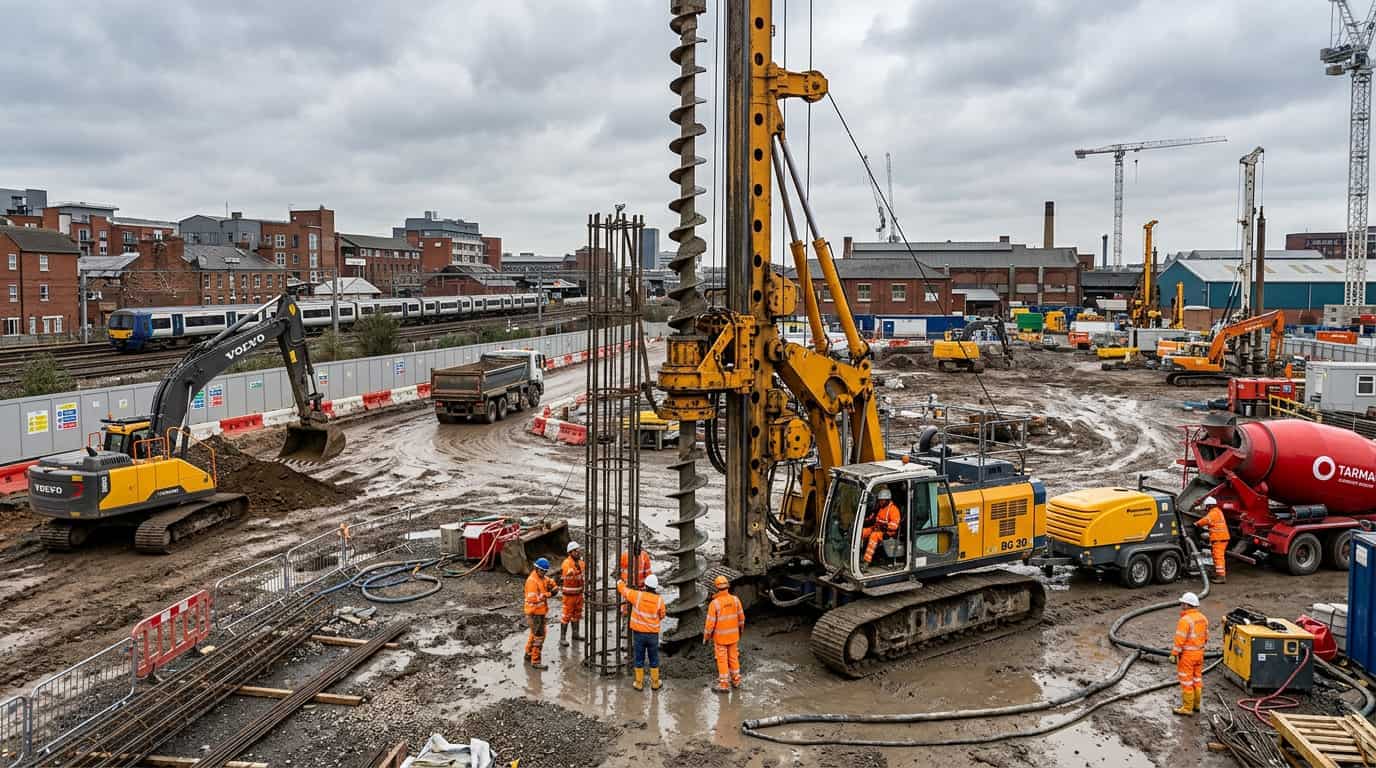
Piling — including mini-piling on constrained plots — introduces specialist plant, testing and often a split between piling and caps/ground beams. See when is piling required?, piling cost and mini piling vs traditional foundations. The commercial risk is awarding a shallow package and discovering piling mid-phase.
Ground improvement followed by shallow foundations creates a two-stage verification path. Improvement must be proven before foundations proceed. Package ownership between improvement and foundation contractors needs a clear hold point.
| Typical option | Commercial characteristics | Common package interfaces | Programme sensitivity |
|---|---|---|---|
| Strip / trench fill / pads | Often lowest visible dig cost where ground allows; sensitive to soft spots | Excavation, concrete, formation testing, BC inspections | Weather and soft-spot volume can move early plot starts |
| Raft | Different excavation/concrete profile; may reduce differential settlement risk where designed for it | Larger pour logistics, edge details, services under/through raft | Pour windows and curing can gate follow-on trades |
| Piled (incl. mini-pile where access constrained) | Specialist plant and testing; different prelims and exclusions | Piling vs caps/ground beams vs plot dig ownership | Rig access, testing and cap construction on critical path |
| Ground improvement + shallow | Two-stage delivery; improvement verification before foundations | Improvement contractor vs foundation contractor split | Verification hold points before plot starts |
Buildability and Access: Where Strategies Fail on Site
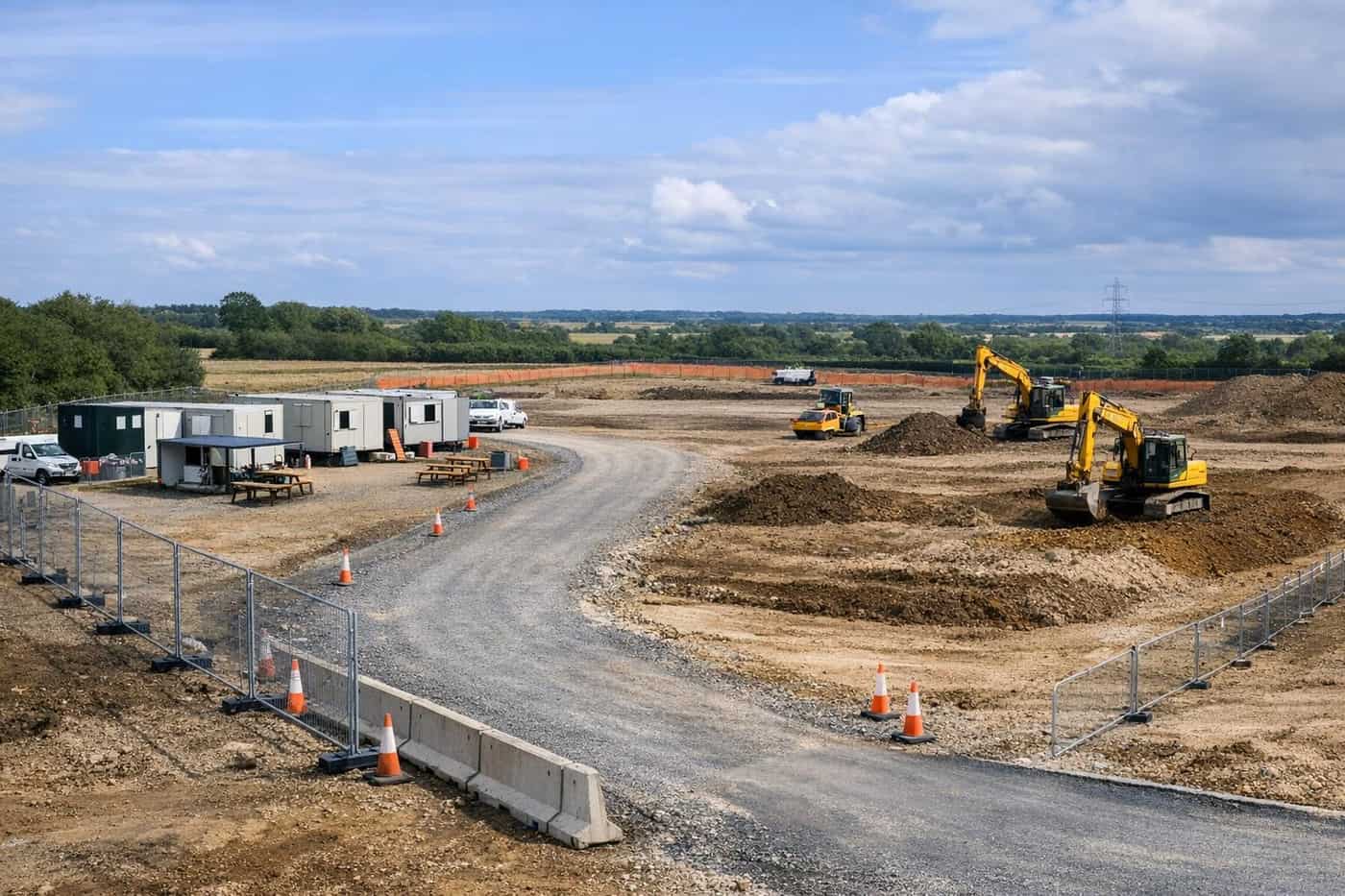
A strategy that ignores access fails at mobilisation. Rig delivery, spoil wagons, concrete pumps and temporary works need corridor width and turning. Estate roads under construction, shared surfaces and neighbour protection can block methods that looked fine on a red-line plan.
Phased housebuilder sites add another layer: early plots may be diggable while later parcels are still cut off by infrastructure trenches or stockpiles. Strategy must survive the actual sequence, not only the completed layout. Link logistics thinking in site logistics planning.
Temporary works are part of strategy when excavations are deep, adjacent to boundaries, or in poor ground. Under-designed temporary works are a false economy that stops the dig and can trigger designer and CDM interfaces. Designer authority remains required for structural temporary works where allocated.
Hypothetical: 90-Plot Phase With a Late Strategy Flip
Imagine a hypothetical 90-plot phase tendered on trench-fill strips with provisional GI recommendations and known made-ground pockets. Award goes to the lowest shallow price. Mid-phase, designer-instructed formation review on a cluster of plots moves those plots to piles; remaining plots stay shallow.
Commercially the project now runs two methods, two testing regimes and a contested package split. The shallow contractor may not hold piling capability; a second specialist arrives; shared access conflicts; plot starts on the piled cluster slip by weeks. Sales had assumed a uniform strip programme. The float disappears into interface management — a typical pattern, not a Mainline case study.
Had strategy been closed — or had ECI tested buildability before award — the tender pack could have split parcels or carried a designed alternative with clear measurement rules. Linking early contractor involvement early is often cheaper than dual-method recovery later.
Building Control, Warranty and Specialist Design Input
Strategy changes that affect structure, heave, retaining or complex temporary works need specialist design input — not contractor improvisation. Warranty and Building Control expectations typically track the approved design and construction records, not informal site decisions.
Keep inspection sequencing aligned with the chosen method. Hold points differ between shallow foundations and piled systems with caps. Use Building Control inspection stages for the inspection narrative, and groundworks QA and inspection records for evidence ownership.
Where foundation strategy interacts with drainage levels and road formation, coordinate early with infrastructure design so plot thresholds and adoptable levels do not fight each other — see the S38 & S104 programme explained.
When Early Contractor Involvement Helps
ECI helps when GI is mature enough to discuss options but design is not frozen, when access is constrained, when package splits are unclear, or when the client wants buildability and programme input before a single-stage price. It is not a substitute for geotechnical design.
ECI is the wrong tool when the client only wants a cheaper strip price with the same incomplete information. That is risk dumping, not involvement. For the ECI process itself, use early contractor involvement. For optioneering discipline more broadly, see groundworks value engineering.
Strategy Freeze Points and Change Control
Define what “frozen enough to tender” means: designer recommendation available, access tested, package splits written, soft-spot rules measurable. Anything less belongs in ECI or provisional mechanisms — not false fixed prices.
After award, strategy changes must travel as designer instructions with measurement rules. Informal site decisions about depth or method create Building Control and warranty exposure — see Building Control inspection stages.
Mixed methods across a phase are workable when ownership is explicit. They fail when the shallow contractor is silently expected to absorb piling without a package framework — lesson from the hypothetical flip above.
Link procurement discipline to tendering groundworks packages and housebuilder packaging to groundworks procurement for housebuilders where residential production applies.
Commercial Consequences of Late Strategy Change
Late flips consume float that sales programmes rarely recover. Dual methods mean dual testing regimes, dual plant, contested access and often a second specialist mobilisation.
Valuations and cash flow suffer because measured work and change accounts collide in the same period. Prelims extend while plots that looked “ready” wait on caps, tests or redesign.
The cheapest prevention is information maturity before competition: GI quality, clear recommendations, and buildability review. Bearing evidence discipline sits upstream — soil bearing capacity explained.
Where change is unavoidable, a recovery protocol — stop stranded plots, re-baseline gates, surge the new method with quality controls — beats opening more digs into chaos (managing multiple plot programmes).
Common Mistakes
Procuring on preferred method rather than designer recommendation.
Leaving piling as an unpriced “if needed” without measurement rules or package ownership.
Ignoring access until the successful tenderer cannot mobilise the priced plant.
Changing superstructure loads after foundation award without redesign.
Treating formation decisions as contractor discretion.
Running dual methods mid-phase without a recovery programme and commercial protocol.
Questions for Designers and Contractors
Ask designers what would flip the strategy, what testing closes the decision, and how trees/groundwater/heave are handled in the drawings you will tender.
Ask contractors how they will deliver the method on the actual access route, how soft spots are measured, and how they will resource a designer-instructed method change without destroying the plot programme.
Ask the commercial team whether tender returns are like-for-like and whether sales gates assume the optimistic foundation case.
Strategy Communication to Sales and Funding Stakeholders
Sales and funding teams need plain-language strategy status: frozen, provisional, or bifurcated with rules. Silence invites assumptions that every plot starts on the optimistic shallow case.
When strategy is provisional, show the decision date and what evidence closes it. Open-ended provisional status destroys programme credibility.
When mixed methods are planned, show which parcels use which method and how package ownership works. Mixed methods without maps become site arguments.
Keep bearing evidence and GI limitations visible in that communication — upstream honesty prevents downstream blame — soil bearing capacity explained.
Strategy Readiness Checklist
1. GI limitations understood; designer recommendation available for the tender drawings.
2. Preferred foundation option buildable with known access and plant constraints.
3. Package splits written: dig / pile / caps / testing / formation ownership.
4. Soft-spot and method-change measurement rules in the tender documents.
5. Building Control / warranty inspection path aligned to the method.
6. Programme float for testing and designer review before critical plot starts.
7. ECI used where strategy is still open; single-stage tender only where strategy is frozen.
8. Infrastructure level interfaces checked so plot foundations do not fight road and drainage design.

Related commercial services
Related infrastructure guides
- Soil bearing capacity explainedEvidence quality and tender risk before foundation packages.Read guide
- Early contractor involvementBuildability input before design and price freeze.Read guide
- When is piling required?Triggers that move strategy from shallow to piled.Read guide
- Strip vs raft foundationsMethod comparison for commercial decision-making.Read guide
Frequently asked questions
Who decides foundation strategy — contractor or designer?
The appointed structural and geotechnical designers decide the engineered strategy. Contractors advise on buildability and price delivery. Mainline does not act as the structural designer.
Can we tender strips and piles as alternatives?
Yes, if the designer has defined both options and tender documents make comparison rules clear. Competing undefined alternatives produces awards that cannot be reconciled.
When should we use ECI instead of a single-stage tender?
When strategy, access or package splits are still open and buildability input would reduce false precision. See the early contractor involvement guide for process detail.
How do trees and clay affect strategy commercially?
They often drive depth, heave precautions and temporary works that change excavation volumes and programme. They should appear in design recommendations before tender, not as site discoveries.
What is the biggest commercial failure mode?
Awarding a shallow fixed price on incomplete evidence, then flipping to piles mid-phase without a pre-agreed package and measurement framework.
Foundation strategy is the bridge between evidence and a package the market can price honestly. Freeze what you can, define change when you cannot, and do not ask contractors to compete across incompatible methods.
Discuss foundation packaging before tender
Share GI status, structural drawings and access constraints and we can discuss how strategies typically translate into deliverable packages — design remains with your structural and geotechnical team.