
Who This Guide Is For
This guide explains attenuation systems for commercial development teams — how surface water storage fits into SuDS strategy, planning, adoption, construction and long-term maintenance. It is written for stakeholders who need to de-risk programmes and protect land value, not for generic product brochures.
Developers need attenuation resolved at feasibility because it affects density, finished floor levels, road geometry, earthworks balance and discharge strategy. A late drainage redesign can unwind a consented layout.
Quantity surveyors should treat attenuation as more than a drainage line item. Excavation depth, dewatering, imported fill, disposal, utility diversions, adoption requirements and future maintenance funding all move the budget.
Procurement managers must decide whether attenuation sits inside a wider civils or roads and sewers package or a specialist attenuation systems appointment — and whether contract terms allocate groundwater and utility risk clearly.
Project managers should sequence attenuation with earthworks, foundations, utilities, highway construction and drainage sign-off. Tank installation often shares the same ground as service corridors and adoptable road build-up.
Housebuilders need SuDS that supports phased plot release, sales packs and management company handover. Visible basins can deliver amenity value if maintenance responsibility is clear from the start.
Main contractors carrying enabling works need interface clarity on temporary works, dewatering, testing, as-built data and adoption inspections where assets are offered under S104.
This guide links to S38 and S104 Programme Explained, S278 Agreements Explained, Utility Diversions, Infrastructure Bonds, Ground Conditions, Groundworks Tendering, NEC vs JCT, Groundworks Costs, Drainage Adoption Process and Adoptable Roads Explained where your scheme needs deeper interface detail.
What Attenuation Systems Are
Attenuation systems are drainage solutions that temporarily store surface water runoff and release it in a controlled way, helping prevent flooding and protect downstream infrastructure. In the UK, they are a core part of sustainable drainage practice and are often expected on developments where impermeable area is being created or increased.
An attenuation system slows the rate at which rainwater leaves a site. Instead of letting stormwater rush straight into sewers, ditches or watercourses, the system stores water during peak rainfall and discharges it later at an agreed rate. This reduces the chance of overloading the receiving drainage network and helps manage flood risk at both site and catchment level.
In development terms, attenuation is usually part of a wider surface water strategy rather than a standalone product. The system may be hidden below ground, or visible as an open basin, pond or swale, but the purpose is the same: keep runoff on site long enough to control peak flow and volume.
Flow control devices — orifices, vortex controls, adjustable valves — set the discharge rate agreed with the Lead Local Flood Authority (LLFA), sewerage undertaker or receiving network owner. Storage volume is sized for the design storm relevant to the planning submission. Both numbers are commercially significant: they drive land take, depth of excavation and adoption route.
Attenuation interacts with foul drainage, highway drainage, foundations and utilities. It is not isolated hydraulics. The most expensive mistakes treat storage volume as the only variable while ignoring where the tank or basin must sit in the masterplan.
Why Attenuation Is Required
Attenuation is required because development typically increases impermeable surfaces such as roofs, roads, yards and car parks. More hardstanding means less infiltration and faster runoff, which can overwhelm sewers and natural drainage pathways during intense rainfall.
UK planning guidance expects surface water runoff to be managed through sustainable drainage systems where development could affect drainage on or around the site. For major development, the expectation is especially clear: SuDS should be used, take account of Lead Local Flood Authority advice, include operational standards, and have maintenance arrangements in place for the lifetime of the development.
Planning conditions also commonly require details of the storage, discharge rate, implementation timetable and maintenance plan before occupation. That makes attenuation a gating item for practical completion and sales — not only a drainage design task.
From a commercial perspective, discharge restrictions protect downstream infrastructure but constrain site layout. A restrictive greenfield rate may force larger storage or deeper tanks. Urban sites with combined sewer context may face different undertaker and LLFA expectations than greenfield estates.
Early engagement with the LLFA and sewerage undertaker on discharge strategy reduces resubmission cycles. Align this with pre-planning drainage enquiries described in the Drainage Adoption Process guide where adoptable sewers are proposed.
SuDS Principles And The Attenuation Role
Attenuation is one part of the SuDS hierarchy, not the whole strategy. The basic SuDS approach is to manage water as close to source as possible, reduce runoff rate and volume, improve water quality where practical, and create wider benefits such as amenity and biodiversity.
In practice, a good SuDS design will try to follow these principles in order: reduce impermeable area where possible; use infiltration where ground conditions allow; store and slowly release runoff where infiltration is not suitable; add treatment stages for water quality where needed; and provide safe exceedance routes for extreme rainfall.
| SuDS principle | What it means in practice | Commercial relevance |
|---|---|---|
| Reduce impermeable area | Minimise hardstanding where layout allows | Lowers storage requirement and land take for attenuation |
| Infiltration where suitable | Soakaways, permeable paving, infiltration trenches | Depends on ground conditions — see GI before assuming viability |
| Store and slowly release | Tanks, ponds, basins with flow control | Core attenuation function; drives civils cost and programme |
| Treatment stages | Silt traps, swales, wetlands where needed | Affects layout, maintenance and adoption route |
| Safe exceedance routes | Overland flow for extreme rainfall beyond design storm | Must be planned — overtopping without a route is a planning and safety risk |
Commercial teams should understand that following the hierarchy can reduce attenuation volume and cost. Permeable paving, green roofs and infiltration features may shrink tank size — but only where ground conditions support them.
Treatment and amenity features affect adoption and maintenance. A wetland or pond may score well in planning and landscape terms but needs long-term management funding and safe design. A buried tank may be less visible but needs access for inspection and silt removal.
Exceedance routing is non-negotiable. Even a well-sized attenuation system can be overtopped in a severe event. Overland flow routes must keep water away from buildings and critical infrastructure — planners and LLFAs expect this demonstrated in the surface water strategy.
Main Attenuation System Types
The main attenuation options on UK developments are tanks, ponds, basins and underground systems. The right choice depends on site area, ground conditions, available space, adoption requirements, maintenance access, and whether the system must also deliver amenity or ecology benefits.
| System type | Typical use | Strengths | Constraints |
|---|---|---|---|
| Tanks | Space-constrained sites, urban plots, phased developments | Compact, predictable storage, can sit under roads or parking areas | Access, inspection, construction sequencing, utility conflicts, cost |
| Ponds | Larger schemes, residential-led masterplans, visible SuDS | Strong biodiversity and amenity potential, easy to understand hydraulically | Land take, safety, groundwater control, landscaping and edge design |
| Basins | Flexible open storage areas that are dry most of the time | Useful where land can be reserved for flood events | Can affect site layout, need safe overland flow and maintenance access |
| Underground systems | Dense urban sites, commercial and mixed-use schemes | Hidden below ground, preserves developable area | High build cost, limited visibility, maintenance strategy critical |
Underground attenuation systems often use crates, cellular units, oversized pipes or precast concrete tanks. Open systems may use ponds, wetlands, swales or dry basins, sometimes in combination with a buried storage layer.
Tanks and underground systems suit dense urban and commercial schemes where developable area is valuable. Ponds and basins suit larger residential masterplans where public open space can dual-purpose as storage. Hybrid schemes — open storage with buried overflow — are common on mixed-use sites.
Adoption route influences type selection. Certain SuDS components may be adoptable under S104 where Design and Construction Guidance criteria are met — including some attenuation tanks under roads. Early undertaker dialogue avoids designing a private system that planning assumed would be adopted.

Planning Requirements
From a planning perspective, attenuation is usually dealt with through a surface water drainage strategy or SuDS report. The information typically needs to explain the existing and proposed layouts, topography, geology, flood risk context, drainage hierarchy, runoff calculations, storage volume, discharge control and maintenance proposals.
For larger or more sensitive sites, planners and the LLFA may want evidence that the proposal has considered alternatives before settling on attenuation. That means showing why infiltration is or is not feasible, how runoff will be restricted, and how the system will operate in ordinary rainfall as well as major storm events.
A common planning mistake is treating attenuation as a late-stage technical detail. In reality, it can affect site density, finished floor levels, road levels, earthworks balance, service corridors and landscape design, so it should be reviewed during feasibility and concept design.
Discharge rates, storage volumes and exceedance routes should be consistent with the S38 and S104 programme for adoptable roads and sewers. Road levels and gully outfalls must match basin or tank inlet levels — misalignment triggers redesign under both highway and undertaker review.
Implementation timetables in planning conditions should reflect real construction sequencing. If attenuation cannot be built until utilities are diverted or S278 access is complete, that dependency should be visible in the drainage strategy submission.
Adoption Considerations
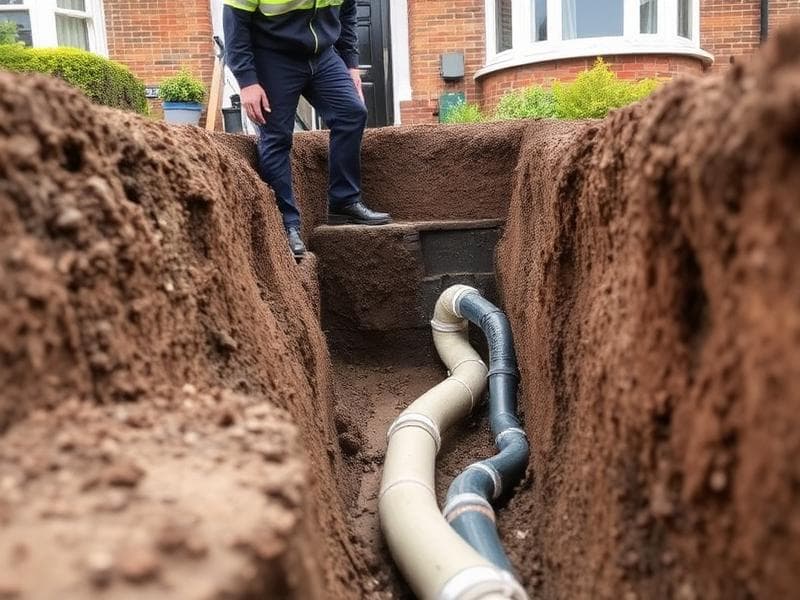
Adoption matters because it determines who will own and maintain the drainage asset after completion. Depending on the layout and what the network connects to, the system may need to be designed for adoption by the local authority, a sewerage undertaker, a management company or remain private.
If a system is intended for adoption, design and access become much more important. Assets usually need to be inspectable, maintainable and located so they can be reached without disrupting buildings or essential operations. Guidance also highlights the value of placing devices in accessible areas such as open space, under access roads or shared parking areas.
Where adoption routes are unclear, the development team should resolve the maintenance and legal structure early. That includes easements, responsibility boundaries, access rights, commuted sums where relevant, and how the drainage feature will remain functional over the life of the project.
S104 adoption of certain SuDS components — including some attenuation tanks — is possible where DCG criteria and undertaker maintenance requirements are satisfied. The Drainage Adoption Process guide covers technical approval, inspections and vesting. Bond exposure on adoptable assets links to Infrastructure Bonds & Sureties.
Highway drainage gullies and road-linked features may fall under S38 rather than S104. Adoptable Roads Explained helps clarify how carriageway drainage interfaces with site-wide attenuation.
Private attenuation retained by a management company needs service charge clarity and funded maintenance. Lenders and conveyancers will ask who owns and maintains storage assets — ambiguity causes sales friction.
Design Constraints
Design starts with the site. Ground level changes, available footprint, geology, groundwater, contamination risk, buildability and the surrounding drainage network all shape the final solution. Where shallow groundwater exists, detailed investigation and monitoring may be needed because groundwater ingress can reduce storage capacity, create buoyancy issues and complicate excavation or liner design.
Limited land availability pushes schemes toward underground storage. High groundwater may rule out infiltration and some below-ground options without liners or dewatering. Steep or irregular sites may need terracing, split catchments or multiple storage nodes. Tight programme windows may affect whether open basins can be constructed before superstructure works. Landscape or public-realm requirements may favour ponds or visible SuDS features.
The hydraulic design also needs to consider exceedance. Even a well-sized attenuation system can be overtopped in a severe event, so overland flow routes should be planned to keep water away from buildings and critical infrastructure.
Split catchments add commercial complexity. A large site may need several attenuation nodes with separate flow controls and maintenance plans. QS teams should price each node with its own excavation, controls and adoption interface — not one lump sum for storage volume alone.
Loading over buried tanks under roads or parking must satisfy highway and structural requirements where adoptable carriageways sit above storage. Coordination with S278 and S38 design is essential on access-heavy schemes.
Construction Challenges
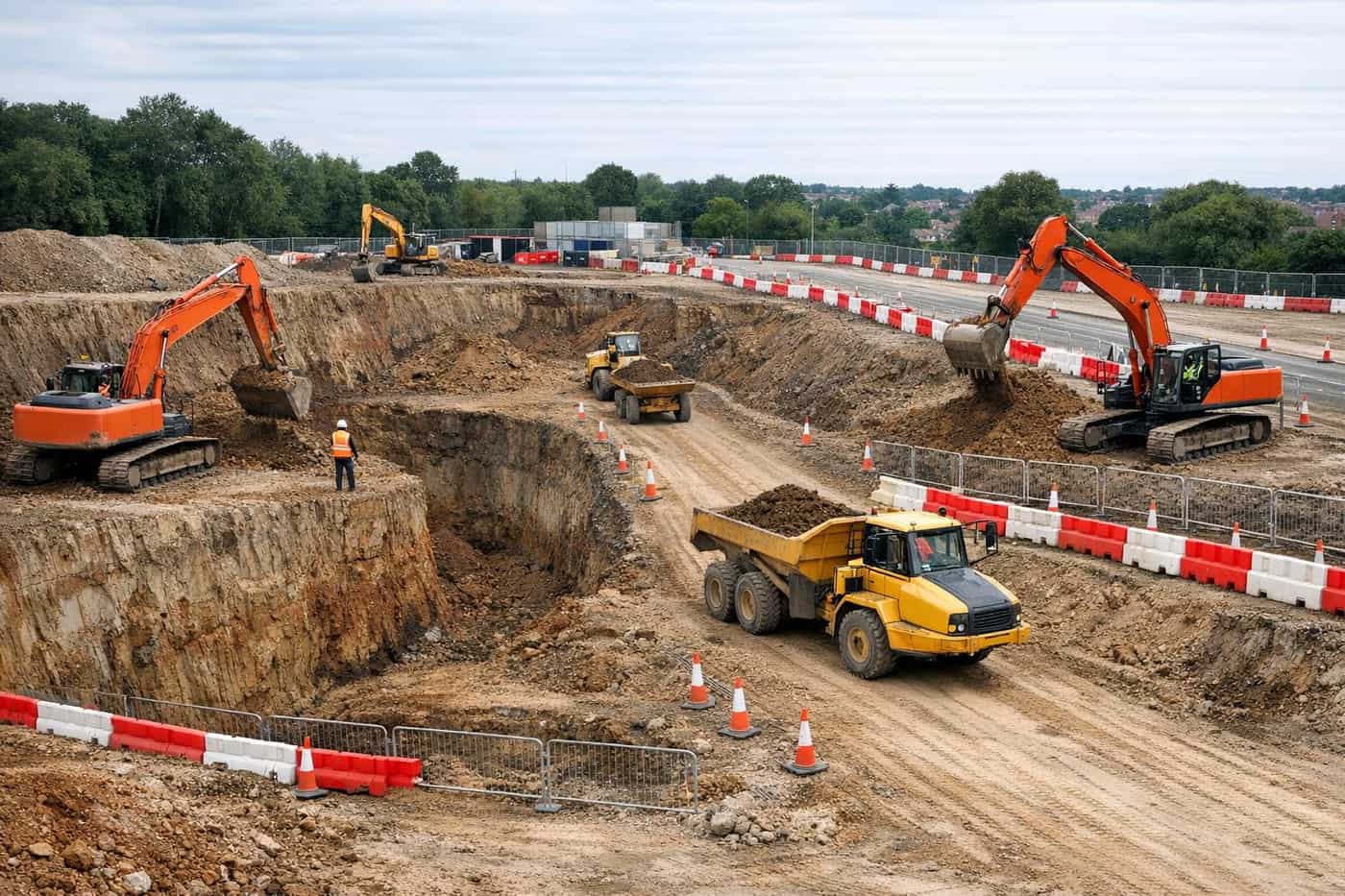
Construction is often harder than the design brief suggests. Underground tanks and crates need accurate excavation, formation control, haulage, safe access, temporary works, compaction control and careful sequencing with highways, structures and utilities. Open systems need earthworks management, lining if required, slope stability, inlet and outlet detailing and landscaping integration.
Groundwater is one of the biggest risks. Where the water table is high or fluctuates, dewatering may be needed during construction, and the permanent design may need liners or additional dead load to prevent uplift or heave. That can increase cost and programme length significantly.
Utility clashes are another frequent issue. Attenuation tanks are often proposed in the same spaces that already carry power, telecoms, gas, foul drains, surface water sewers and duct routes, so utility coordination should happen before the drainage layout is frozen. Early utility survey work and diversion planning can save a great deal of rework — see Utility Diversions for Development Sites.
Compaction and formation level control under crates and tanks affects long-term settlement and road build-up above. Failed formation inspections delay road construction and adoptable highway milestones.
Phased developments need a clear strategy for temporary drainage during construction. Storage may not be complete while plots are building out — interim flows and silt management must be planned to avoid polluting downstream networks or blocking adoptable sewers.
Maintenance Responsibilities
Attenuation systems only work long term if they are maintained. Maintenance typically includes inspection of inlets and outlets, removal of silt and debris, checking control devices, vegetation management, structural checks and ensuring any flows are not being blocked by later site changes. Planning guidance specifically expects maintenance arrangements to be in place for the lifetime of the development.
Who is responsible depends on the ownership model. Some systems sit with a management company, some with a public authority or sewerage undertaker, and some remain under the developer's or freeholder's control until a transfer point is reached. If the system is not clearly assigned, it can become neglected once the site is occupied, which is one of the most common causes of underperformance.
The practical lesson is that maintainability should be designed in, not added later. Access covers, inspection chambers, safe working zones, replacement strategy and long-term funding all need to be considered before the first trench is dug.
O&M manuals, as-built information, ownership documents and inspection responsibilities should be explicit at handover. Poor handover undermines even well-designed systems — a common failure mode on completed schemes.
Maintenance funding affects sales and service charges on residential schemes. Commercial estates need a named responsible party and inspection schedule in the asset management plan.
Cost Implications
Cost depends heavily on the chosen system type, land value and site constraints. Underground attenuation is often more expensive per cubic metre of storage than open basins or ponds, but it can make sense where every square metre of developable land matters. Open systems may be cheaper to build but can consume valuable area and require more landscape treatment.
| Cost driver | Why it matters | Planning mitigation |
|---|---|---|
| High groundwater | Dewatering, liners, buoyancy control, reduced infiltration | GI and monitoring before design freeze; budget dewatering in programme |
| Utility diversions | Tank zones often clash with service corridors | Utility survey and coordination before attenuation layout is fixed |
| Tight site access | Haulage, crane limits, phased delivery of crates or precast units | Sequence with enabling works and temporary access strategy |
| Complex outfalls | Restricted discharge rates, off-site connections, pumping | Early undertaker and LLFA engagement on discharge strategy |
| Adoption requirements | Inspectable, maintainable design under S104 or private management | Resolve adoption route at concept — see drainage adoption guidance |
Costs usually increase when a site has high groundwater or poor soils, utility diversions, tight access for plant, complex outfall arrangements, infill or constrained brownfield layouts, or enhanced maintenance and adoption requirements.
For development teams, attenuation is not just a drainage line item. It affects land-take, build sequence, earthworks, utility strategy, legal adoption route and future operating cost, so it should be included in early feasibility and cost planning rather than left to technical design.
Use groundworks pricing calculator to sense-check excavation, disposal, dewatering and temporary works alongside storage unit supply costs. The civils envelope often moves the budget more than the crate or tank product.
Procurement should separate provisional sums for utility diversions and ground risk from storage installation. The Groundworks Tendering Guide supports comparable civils returns when scope is split clearly.
Ground Conditions And Infiltration
Ground conditions are decisive in choosing between infiltration and attenuation. If soils are permeable and groundwater is low, infiltration features may reduce the amount of storage required. If the ground is clay-rich, contaminated, unstable or waterlogged, infiltration may be unsuitable and a controlled discharge solution becomes more realistic.
A proper ground investigation should look beyond a basic desk study. Developers should consider permeability testing, groundwater monitoring and the interaction with adjacent structures, basements, retaining walls and cut and fill levels. This is especially important on brownfield land where past use may also affect liner design, treatment measures and excavation strategy.
Read Ground Conditions Explained alongside drainage design because soil type, groundwater and made ground can completely change what good drainage looks like on a project.
Buoyancy and heave affect buried tanks in high groundwater. Permanent ballast, liners or structural slabs may be required — items that are easy to miss at feasibility if GI is shallow.
Contamination may require lined systems and controlled disposal of excavated material, adding cost and programme to open and closed storage alike.
Utility Conflicts
Utilities can make or break an attenuation layout. Underground storage often sits in the same zones as foul, water, gas, power, telecoms and incoming service routes, which creates clashes during both design and construction. If a tank is already fixed in a preferred location, utility diversions may become unavoidable and can have major programme and cost implications.
The safest approach is to coordinate drainage with the utility strategy from the start. That includes checking wayleaves, easements, service corridors, loadings over buried assets and access requirements for future repair.
For projects with complex service repositioning, drainage and utility teams should align design with Utility Diversions for Development Sites before planning is locked in.
Statutory undertaker programmes often exceed civils mobilisation lead times. A tank cannot be excavated safely over an unmoved gas main — diversion milestones belong on the critical path with attenuation construction.
Loadings and easements over buried utilities affect where tanks can sit under roads. Highway and undertaker adoption reviews both ask whether future utility repair is possible without destroying storage assets.
Programme And Statutory Interfaces
Attenuation rarely sits in isolation on a development programme. It often affects earthworks, foundations, road construction, utility installation and the timing of drainage sign-off, so it should be linked to wider enabling works and statutory coordination.
Teams often coordinate attenuation alongside the Drainage Adoption Process and S38 and S104 Programme Explained guides because storage, flow controls and outfalls must align with adoptable sewer and highway milestones.
Earthworks balance and cut-fill strategy interact with basin formation and tank depth. Finishing road levels before storage depth is agreed can trap the design in conflicting level loops.
Building control and plot occupation may depend on surface water management being operational. Programme float should exist for testing, commissioning of flow controls and planning discharge of condition.
Contract administration on complex civils packages benefits from clear notice procedures where groundwater or utility delay affects tank installation — see NEC vs JCT for Groundworks Projects.
The Roads & Sewers Contractors Guide covers how adoptable infrastructure sequencing affects wet and dry packages together.
Common Commercial Mistakes
The most common mistake is underestimating how early attenuation affects the masterplan. Once levels, road geometry and building footprints are fixed, it becomes much harder to find space for storage without compromising adoptable roads, foundations or service runs.
Other frequent mistakes include assuming infiltration will work without adequate evidence; ignoring groundwater and buoyancy risk; failing to plan maintenance access; treating the system as a private detail with no adoption strategy; not allowing for exceedance during extreme events; and missing utility conflicts until construction.
A second common failure is poor handover. Even a well-designed system can be undermined if O&M manuals, as-built information, ownership documents and inspection responsibilities are vague at completion.
Tendering attenuation without GI, utility records or adoption status produces non-comparable returns. Contractors price different exclusion sets; the lowest bid often omits dewatering or diversion risk.
Designing storage volume without confirming discharge rate with the LLFA or undertaker forces resubmission after planning — wasting time when civils procurement was already underway.
Attenuation is easiest to deliver when treated as a project-wide constraint from day one. The best schemes are those where drainage, planning, civils, utilities and commercial teams work from the same concept design.
Developer Checklist Before Freezing Drainage Strategy
Use this checklist before concept design is frozen, planning submission or civils tender issue.
Related project scenarios
Dense urban commercial development
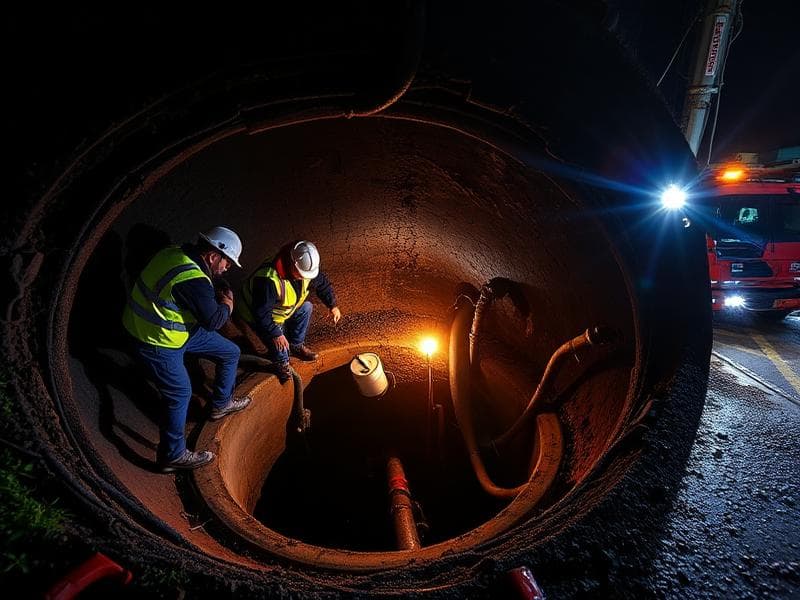
Mixed-use scheme with minimal open land, restricted discharge rate and underground storage required beneath parking and service yards.
Procurement challenge: Below-ground attenuation was the only practical choice, but the preferred tank zone conflicted with existing HV cable routes and a foul sewer diversion programme. Access for crate delivery was constrained by a live S278 junction widening package.
Commercial outcome: Programme: utility diversion and tank excavation sequenced after S278 lane closure windows — six-week slip on drainage completion. Cost: revised tank footprint, additional diversion quotes and dewatering during high groundwater. Procurement: civils tender lacked utility corridor assumptions; normalised returns after survey update. Delivery: phased tank install with flow controls tied to estate road surfacing milestones.
Suburban housing estate
Residential-led masterplan with visible SuDS, public open space and adoptable estate roads requiring coordinated surface water discharge.
Procurement challenge: An attenuation basin integrated with open space was hydraulically strong but land-take reduced net developable area. Adoption strategy for surface water assets under S104 needed alignment with S38 road drainage levels before technical approval.
Commercial outcome: Programme: basin earthworks completed before superstructure on first phase — protected downstream plot release. Cost: lower storage cost per cubic metre than underground alternative; landscape treatment included in public realm budget. Procurement: single roads and sewers package owned basin and carriageway interfaces. Delivery: basin maintenance assigned to management company with clear handover documentation.

Brownfield mixed-use regeneration
Former industrial site with shallow groundwater, contamination constraints and infiltration ruled out by ground conditions and LLFA advice.
Procurement challenge: Conventional infiltration was unrealistic. Design shifted to lined storage with controlled discharge and enhanced monitoring. Made ground and high water table increased excavation and temporary works complexity.
Commercial outcome: Programme: dewatering and liner install added two months to wet infrastructure critical path. Cost: higher upfront civils than infiltration-led strategy, but more reliable planning justification. Procurement: NEC target cost with shared GI data reduced ground-risk disputes. Delivery: controlled discharge strategy accepted at planning; monitoring regime embedded in O&M handover.
Related commercial services
Related infrastructure guides
- Drainage Adoption ProcessS104 adoption for adoptable surface water assets.Read guide
- S38 & S104 Programme ExplainedIntegrated roads, sewers and drainage programme.Read guide
- Adoptable Roads ExplainedHighway drainage and carriageway interfaces.Read guide
- S278 Agreements ExplainedHighway works affecting access and drainage sequencing.Read guide
- Utility Diversions for Development SitesService corridors and tank zone conflicts.Read guide
- Ground Conditions ExplainedInfiltration, groundwater and excavation risk.Read guide
- Groundworks pricing calculatorFeasibility costing for civils and storage works.Read guide
- Groundworks Tendering GuideProcuring attenuation within civils packages.Read guide
- Roads & Sewers Contractors GuideCombined adoptable infrastructure delivery.Read guide
- Infrastructure Bonds & SuretiesBond exposure on adoptable drainage assets.Read guide
- NEC vs JCT for Groundworks ProjectsContract risk on groundwater and utility delay.Read guide
Frequently asked questions
What is the purpose of an attenuation system?
Its purpose is to store surface water temporarily and release it at a controlled rate so downstream drains, sewers and watercourses are not overloaded during peak rainfall.
Is attenuation the same as SuDS?
No. Attenuation is one component of SuDS. SuDS is the wider approach to managing surface water sustainably, including infiltration, storage, treatment and amenity benefits.
Do all developments need attenuation?
Not every development needs the same solution, but many schemes need a surface water strategy that demonstrates how runoff will be managed. Where a site increases impermeable area or could affect drainage, planning authorities commonly expect SuDS-based control measures.
When is attenuation required by planning?
Where development increases impermeable area or could affect drainage on or around the site, UK planning guidance expects surface water to be managed through SuDS. Major development is generally expected to use SuDS, follow LLFA advice, meet operational standards and have lifetime maintenance arrangements.
Can attenuation tanks be adopted?
Yes, in some circumstances. Adoption depends on the network, asset type and receiving authority. Certain tanks and SuDS components may be adoptable under S104 where design and maintenance criteria are met — see Drainage Adoption Process.
Are ponds better than tanks?
Neither is always better. Ponds are often stronger for landscape and biodiversity on larger schemes, while tanks are often better where land is tight and storage must be hidden below ground.
What is a Lead Local Flood Authority (LLFA) role in attenuation?
The LLFA advises on local flood risk and surface water management. For major development, SuDS proposals are generally expected to take account of LLFA advice on discharge rates, storage and exceedance.
How do ground conditions affect attenuation design?
Permeable soils and low groundwater may allow infiltration that reduces storage volume. Clay, contamination, made ground or high groundwater usually push designs toward lined storage and controlled discharge — see Ground Conditions Explained.
What causes attenuation schemes to fail in practice?
Common causes include poor masterplan integration, incorrect ground assumptions, missed utility clashes, lack of maintenance access, unclear ownership after handover, and inadequate exceedance routing.
How do utilities affect attenuation layout?
Underground storage often shares space with foul, water, gas, power and telecoms routes. Clashes can force diversions with major programme and cost impact — coordinate early via Utility Diversions for Development Sites.
How does attenuation interact with S38 and S104?
Road drainage under S38 and adoptable surface water sewers under S104 must align on levels, outfalls and storage. Integrated programme management avoids redesign — see S38 & S104 Programme Explained.
What is exceedance routing?
Exceedance routing is the planned path for water when rainfall exceeds the design storm and storage fills. Safe overland flow must keep water away from buildings and critical infrastructure.
Who maintains attenuation systems after completion?
Responsibility depends on ownership: management company, sewerage undertaker, highway authority, developer or freeholder until transfer. Maintenance arrangements should be defined for the lifetime of the development.
Is underground attenuation more expensive than open basins?
Often yes per cubic metre of storage, but underground systems can preserve developable land value on dense sites. Open systems may cost less to build but consume land and need landscape treatment.
What planning information is needed for attenuation?
Typically topography, geology, flood risk context, drainage hierarchy, runoff calculations, storage volume, discharge control, exceedance routes, implementation timetable and maintenance proposals in a surface water drainage strategy or SuDS report.
Can infiltration replace attenuation?
Where ground conditions allow, infiltration features may reduce required storage. Many sites still need attenuation with controlled discharge where infiltration is unsuitable or restricted.
How should attenuation be procured?
It may sit within wider groundworks, roads and sewers or specialist drainage packages. Tender scope should include GI, utilities, testing, adoption liaison and dewatering — see Groundworks Tendering Guide.
Does high groundwater affect tank construction?
Yes. High or fluctuating groundwater can require dewatering during construction and permanent liners or ballast against buoyancy, increasing cost and programme length.
What should be handed over at completion?
As-built drawings, O&M manuals, ownership documents, flow control settings, inspection schedules and maintenance funding arrangements. Poor handover is a common cause of long-term underperformance.
How does attenuation affect project programme?
It sequences with earthworks, utilities, foundations, road build and drainage sign-off. Delays on diversions, dewatering or adoption approval directly delay storage completion and plot release.
Attenuation is not a drainage detail you bolt on after the masterplan is drawn. It is a site-wide constraint that shapes density, levels, adoption, utilities, civils cost and long-term liability. The schemes that deliver smoothly treat storage and flow control as part of the same commercial picture as roads, sewers and enabling works — not as a separate hydraulic calculation.
For developers, quantity surveyors, procurement managers, project managers, housebuilders and main contractors, the commercial test is straightforward. Can you explain where water is stored, how fast it leaves, who maintains it, what happens in an extreme storm, and how that fits the adoption and sales programme? If those answers are vague at tender, they will be expensive at construction.
Use the checklist and related guides in this resource to pressure-test feasibility before planning and procurement lock in. Then deliver attenuation with ground evidence, utility coordination, maintenance access and handover documentation written into scope — not assumed in contingency.
Mainline Groundworks supports attenuation and wider SuDS delivery across residential, commercial and regeneration schemes — from concept drainage strategy through attenuation systems construction, commercial drainage interfaces and adoptable network coordination. Share your LLFA context, storage strategy and programme and we will advise on delivery and procurement options.
Discuss attenuation on your scheme
Share your SuDS strategy, storage requirements and programme — we will advise on design coordination, procurement and delivery.