
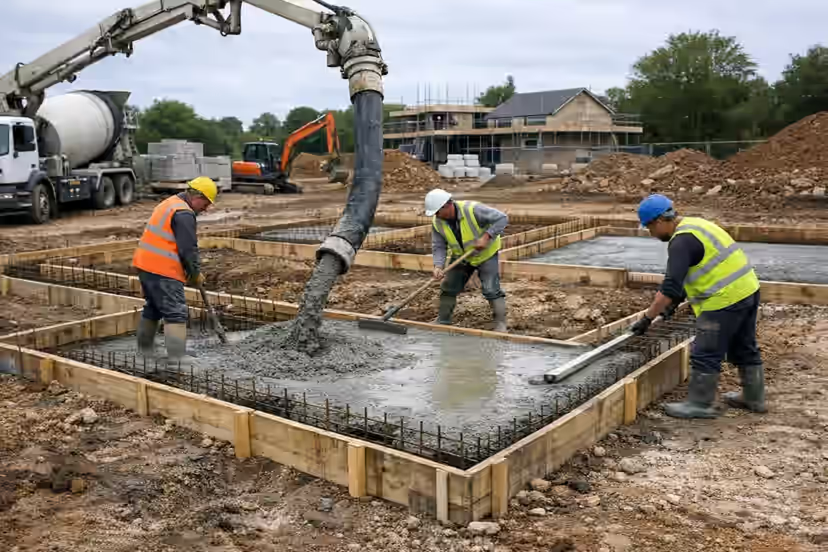
Concrete Foundation in Oxford
Trusted concrete foundation serving Oxford and Oxfordshire.
- Fully Insured
- Commercial & Site Work Specialists
- 5 Star Rated
- Emergency Callout
We cover the wider South East area, including Oxfordshire.
Concrete foundations in Oxford are commonly procured for college, conservation, residential and commercial schemes across Oxfordshire where formation acceptance, pour logistics and ground variability matter as much as the pour itself. Around Headington, Cowley, Abingdon and Kidlington, the useful local question is whether strip, raft or pad foundations can found on competent Thames terrace gravel or engineered formation — or whether piled interfaces are needed through soft cover, made ground or high-volume-change clay — while pump access, neighbour constraints and concrete specification stay on the same programme.
Getting scope and method aligned early usually protects programme certainty when conditions on site are variable.
It is commonly used across new-builds, remedial programmes, and upgrades where technical choices affect programme, cost, and ongoing performance.
The goal is to resolve the underlying need with a practical method that fits the site and the intended outcome.
We provide concrete foundation across South East, including Oxford and the wider Oxfordshire area, for typical residential and commercial project requirements.
This area sits within Oxfordshire, where we support projects across Oxford and nearby centres for both residential and commercial clients.
Related services
Compare service overviews that are often scoped alongside this work.
Local coverage around Oxford
Oxford and the wider Oxfordshire region see a mix of housing, commercial and infrastructure projects. Our Concrete Foundation teams work with developers and main contractors across the area, including in Headington, Cowley, Abingdon and Kidlington. We deliver piling, excavation, foundations and site preparation to programme, with free no-obligation quotes for projects in and around Oxford.
Nearby areas we cover include:
- Aylesbury
- High Wycombe
- Reading
- Swindon
- Maidenhead
- Milton Keynes
- Slough
- Hemel Hempstead
Technical delivery considerations for Oxford
Concrete foundation delivery combines accepted formation, reinforcement and cast-in coordination, concrete supply, placement method, testing, curing and dimensional control. Quality is determined before and during the pour, so design queries, logistics and inspection hold points must be resolved in advance.
For concrete foundation work in Oxfordshire, local relevance comes from delivery access, pump positioning, neighbour constraints, pour windows and the project formation—not repeatedly naming the location. Concrete specification and release criteria remain controlled by the structural design.
The local location dataset describes the area as: Georgian townhouses, Victorian terraces, period colleges and modern developments
Engineering workflow
Stage 1
Pour planning and design review
Coordinate concrete specification, reinforcement, cover, joints, cast-ins, pour sizes, pump access, testing and weather controls against the structural sequence.
Output: Pour plan, inspection points and concrete call-off schedule.
Stage 2
Formation, blinding and reinforcement
Accept formation, install blinding or formwork and fix reinforcement with the specified cover, laps, starter bars and embedded items.
Output: Recorded pre-pour inspection and dimensional check.
Stage 3
Placement and quality control
Receive, place and compact concrete in a controlled sequence, monitoring delivery information, workability, test samples, levels and finish.
Output: Pour record, delivery tickets and test sample register.
Stage 4
Curing and handover
Protect the concrete, manage striking or loading restrictions, review test results and close out levels, surfaces and any remedial items.
Output: Strength, survey and completion records for structural release.
Local site constraints to confirm
- Restricted pump setup or delivery-vehicle access
- Long pump lines and congested reinforcement
- Limited washout, storage and safe concrete-testing areas
- Pour windows coordinated with neighbours or other trades
Preparation before mobilisation
- Resolve design queries, bar schedules and cast-in information before fixing begins.
- Book concrete, pump, testing and inspection resources against the pour sequence.
- Provide clean access, lighting, washout and contingency arrangements.
- Agree curing, protection and the earliest permitted follow-on loading.
Scope clarity and handover
Commercial deliverables
- Pour plan and pre-pour inspection records
- Reinforcement and material certification where required
- Concrete delivery tickets, sample and test results
- Curing and weather-protection record
- As-built level, position and close-out information
Typical exclusions to resolve
- Structural design and reinforcement detailing unless included
- Formation remediation and dewatering outside the agreed allowance
- Concrete pumping, testing or reinforcement supply where stated as attendance
- Post-handover loading damage or alterations by following trades
Ground context around Oxford (screening only)
BGS regional geology for London and the Thames Valley describes Mid- to Late Jurassic mudstone of the Ancholme Group forming a belt of low-lying country through Oxford, with the Oxford Clay in the lower part. In Oxfordshire the Corallian Group — limestone and sandstone that form more resistant hills — intervenes in that mudstone succession, and Kimmeridge Clay continues the clay sequence above. Those bedrock units are commonly concealed by Quaternary Thames terrace deposits that matter for shallow foundation screening.
The BGS Lexicon records the Summertown-Radley Sand and Gravel Member (type area River Thames, Oxford to Abingdon) as predominantly cold-phase sands and gravel up to about 6 m thick, dominated by Middle Jurassic limestone clasts, resting on Jurassic bedrock. The younger Northmoor Sand and Gravel Member underlies the modern floodplain terrace (surface typically up to about 3 m above the alluvial floodplain), usually around 3 m thick and locally thicker, often under Holocene alluvium. BGS Open Report OR/08/030 on the Thames floodplain around Oxford notes Summertown-Radley remnants a few metres above the floodplain (largest patch under north Oxford) and Northmoor gravels typically 2–4 m thick from Cassington to Sandford-on-Thames, thickening locally; springs often mark the gravel contact with Oxford Clay. Soft alluvium, variable gravel density, made ground and bedrock clay can therefore change over short distances — foundation depth, formation level and concrete sulphate class must follow the plot GI and structural design, not a town-wide assumption.
Strip, raft, pad or piled — choosing the interface on Oxfordshire ground
Where investigation finds competent dense Summertown-Radley or Northmoor gravel beneath any made ground or soft terrace clay, strip, trench-fill or pad foundations are often the economical commercial route, provided formation is accepted at the design level and trees or volume-change risk in nearby clay are addressed in the structural package. Rafts (ground-bearing or on improved ground) are commonly considered where loads need spreading, differential settlement must be limited, or a continuous working surface is needed for follow-on frames — still subject to GI and engineer sign-off.
Piled foundations (with pile caps, ground beams or piled rafts) become the practical interface where soft floodplain cover, deep compressible clay, heavy commercial loads, settlement limits, or tree-related clay heave/shrinkage mean shallow founding is not reliable. Oxford Clay and related Jurassic mudstones can present shrink–swell and sulphate/aggressivity considerations that only site testing and BRE SD1 / structural specification resolve — so concrete designation, cover and formation protection belong in the design package, not a generic mix card. A buildable Oxford foundations package should join GI conclusions, formation acceptance criteria, method (strip/raft/pad vs piled), pump and access logistics, pour windows and testing into one sequence before mobilisation.
- Confirm GI strata, groundwater and sulphate/aggressivity notes before locking foundation type
- Accept formation (or remediation) against the structural design — not a street-name assumption
- Decide early whether the package includes blinding, formwork, reinforcement supply, pumping and testing
- On clay plots, align tree influence, volume-change assumptions and pour/cure protection with the engineer
Constrained Oxford pours — access, colleges and conservation logistics
Central Oxford and many college or conservation sites work within narrow historic lanes, listed boundary walls, limited compound space and live neighbour or academic operations. Published Oxford construction case studies repeatedly show timed deliveries, banksmen, vehicle-size limits, holding areas off the ring road, and boom or line pumps used where mixer trucks cannot reach the pour face. Those constraints are programme-critical for concrete foundations: reinforcement fixing, cast-ins, pour size, washout and cube sampling all need a realistic logistics plan before concrete is called off.
Outside the historic core — Headington, Cowley, Abingdon, Kidlington and similar Oxfordshire centres — access is often easier, but ring-road congestion, shared commercial yards and neighbour working-hour limits still shape pump positioning and pour windows. The local value on this page is planning formation, reinforcement and placement around those constraints, not renaming a London template.
- Map mixer and pump access, line length and washout before finalising pour sizes
- Agree neighbour, highway and working-hour constraints for college or conservation plots early
- Hold design queries, bar schedules and cast-in information before fixing starts
- Protect curing and earliest follow-on loading against the structural release criteria
What to send for an Oxford concrete foundations quote
Useful tender information includes structural drawings and loads, current ground investigation (strata, groundwater, sulphate/pH and any made-ground notes), proposed foundation type and formation levels, pour sequence, pump and delivery access, and whether reinforcement, blinding, formwork, testing and curing protection are included. For Oxford and Oxfordshire plots — especially constrained college, conservation or town-centre sites — photographs of access routes help, but GI, formation criteria and a clear pour/access plan are what confirm method and programme risk.
We Also Cover
Headington, Cowley, Abingdon, Kidlington and surrounding areas in Oxfordshire.
Common Property Types in Oxford
Georgian townhouses, Victorian terraces, period colleges and modern developments
Why choose us for concrete foundation in Oxford?
When you need concrete foundation locally, you need clear advice, dependable delivery, and a team that understands the practical constraints in Oxford and Oxfordshire.
Trusted Groundworks Contractors in Oxford
We focus on clear communication, reliable delivery, and practical outcomes from first contact through completion.
- Years of experience in Oxfordshire
- Fully insured and accredited
- Programme-led delivery
- Quality assured and certified
Before you begin
Before work begins, confirm access constraints, programme expectations, and how this scope fits with any related works so delivery can stay efficient.
Need guidance before starting concrete foundation work?
Share your site details and priorities in Oxford; we will recommend the right scope, likely timeline, and practical next step.
Discuss Your ProjectNeed concrete foundation in Oxford?
Tell us what you need and we will advise on the right approach, timeline, and next step for your property.
Discuss Your ProjectGet a Free Quote
Contact us for a no-obligation quote or to discuss your project. We'll advise on the best approach and provide clear pricing.
Discuss Your ProjectGet a quote
Discuss Your Project- Years of experience in Oxfordshire
- Fully insured and accredited
- Programme-led delivery
- Quality assured and certified
Helpful guidance related to this service
These guides explain common issues, planning considerations, and practical decisions related to this service.
Frequently Asked Questions
What must be checked before a concrete foundation pour for a project in Oxford?
Check formation and dimensions, cleanliness, blinding or formwork, reinforcement size and cover, laps, cast-ins, service entries, access, concrete specification, testing and the agreed inspection release.
What concrete records should be retained for a project in Oxford?
Depending on the specification, retain delivery tickets, pour location and timing, sample or cube records, test results, weather and curing notes, inspection records and as-built survey information.
Why is concrete volume only an estimate before excavation for a project in Oxford?
Actual formation dimensions, overbreak, blinding, level variation and design changes affect volume. Survey and disciplined excavation improve accuracy, but call-offs still need a controlled contingency.
When can follow-on work load a new concrete foundation for a project in Oxford?
Loading should follow the structural specification and confirmed concrete strength, not a generic elapsed time. The project team should agree the release criteria and protect the foundation during curing.
Do you provide concrete foundations in Oxford?
Yes, we provide concrete foundations throughout Oxford and Oxfordshire for commercial and residential projects.
Nearby Areas We Serve
Compare our Concrete Foundations in nearby areas.
Need Concrete Foundation in Oxford?
Contact us today for a free, no-obligation quote.
Discuss Your ProjectGet your project moving
Share your drawings, scope or programme and we will point you to the right next step.